

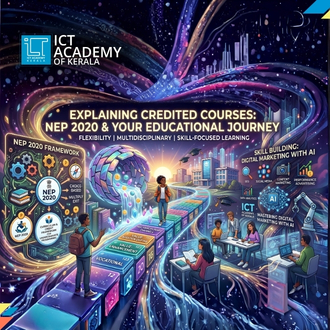
Education continues to change under the National Education Policy (NEP) 2020. NEP 2020 promotes flexible, inclusive, multidisciplinary, and holistic learning. It encourages students to build academic knowledge along with critical thinking, problem-solving, communication, creativity, and other skills for the modern workplace.
The Curriculum and Credit Framework for Undergraduate Programmes (CCFUGP) supports this approach. It gives students more flexibility through a choice-based credit system, multidisciplinary learning, and multiple entry and exit options. Students can choose courses and learning pathways that match their interests and career goals.
Credited courses can help learners connect academic education with practical skills. For example, digital marketing courses can help students learn SEO, social media marketing, content marketing, analytics, performance advertising, and AI-powered marketing.
What Is a Credited Course?
A credited course carries a specific number of academic credits within an approved credit framework. Institutions use credits to measure a learner’s academic workload and progress.
The Curriculum and Credit Framework includes several course categories, such as:
- Multidisciplinary Courses
- Ability Enhancement Courses
- Skill Enhancement Courses
- Value-Addition Courses
- Work-based vocational courses
These course options allow students to develop knowledge and practical skills beyond their main area of study.
What Is the NEP 2020 Credit Framework?
The NEP 2020 Credit Framework makes higher education more flexible and student-centred. The UGC’s Curriculum and Credit Framework for Undergraduate Programmes supports a choice-based credit system, multidisciplinary learning, and multiple entry and exit options.
The framework encourages students to:
- Develop their individual abilities
- Choose learning paths that match their interests
- Explore different academic disciplines
- Understand concepts instead of relying only on memorisation
- Improve critical thinking and decision-making
- Build communication and teamwork skills
- Develop leadership and life skills
- Use technology as part of their learning
This approach connects academic education with practical and career-focused learning.
Why Do Credits Matter in Education?
Credits help institutions measure and organise academic learning. They also help students track their progress throughout a programme.
The credit framework recognises different types of learning activities, including:
- Lectures
- Tutorials
- Practical work
- Laboratory activities
- Seminars
- Internships
- Studio activities
- Field projects
- Community engagement
- Skill enhancement courses
Students can therefore learn through both classroom education and practical experiences.
Example of a Credited and Skill-Based Course
ICT Academy of Kerala (ICTAK) offers industry-focused courses such as Mastering Digital Marketing with AI. The course helps learners develop practical skills in SEO, social media marketing, content marketing, analytics, advertising, and AI-powered marketing.
Learners should remember that a skill-based course and an academically credited course are not always the same. Before enrolling, check whether the course officially carries academic credits and who accepts them.
Benefits of Credited and Skill-Based Courses
Build Practical Skills
Skill-based courses help students apply what they learn. Practical activities can help learners understand how businesses use knowledge in real situations.
Support Career Development
Additional skills can help students explore different career opportunities. Digital marketing skills can support careers in SEO, social media, content marketing, paid advertising, analytics, and other digital roles.
Encourage Flexible Learning
The NEP 2020 framework gives learners more flexibility when they choose their learning pathways. Students can explore courses based on their interests and career goals.
Promote Multidisciplinary Learning
Students can explore subjects and skills outside their main academic discipline. This approach can help them develop a broader knowledge base.
Develop Employability Skills
Students can strengthen communication, teamwork, critical thinking, creativity, problem-solving, and other skills that employers value.
What Is the Academic Bank of Credits?
The Academic Bank of Credits (ABC) supports the credit-based education system under NEP 2020.
ABC works as a digital platform where students can store and transfer academic credits earned from recognised higher education institutions. It supports flexible learning pathways and helps learners manage their academic credits.
The Academic Bank of Credits supports the larger goal of giving students greater flexibility in their education.
What Should You Check Before Choosing a Credited Course?
Before you join a credited course, check the following:
- Course provider: Who offers the course?
- Credit status: Does the course officially carry credits?
- Credit recognition: Who recognises the credits?
- Credit value: How many credits does the course provide?
- Course content: What subjects and skills does it cover?
- Practical training: Does the course include hands-on learning?
- Projects or internships: Does the course provide practical experience?
- Certification: What certificate or qualification will you receive?
- Eligibility: Do you meet the course requirements?
- Career value: Does the course support your career goals?
These questions can help learners choose a course that matches their educational and professional needs.
Credited Course vs Certificate Course
A credited course and a certificate course do not always mean the same thing.
A certificate usually confirms that a learner completed a course or training programme. A credited course carries a defined credit value within a particular academic or credit framework.
Therefore, learners should not assume that every course that provides a certificate also provides academic credits. Always check the course’s credit status and recognition before enrolling.
Conclusion
The NEP 2020 Curriculum and Credit Framework promotes flexible, multidisciplinary, and skill-focused education. It gives learners more opportunities to choose courses based on their interests while developing academic knowledge and practical skills.
Digital marketing offers one useful path for learners who want to develop career-focused skills. The ICT Academy of Kerala’s Mastering Digital Marketing with AI programme helps learners explore SEO, social media marketing, content marketing, performance advertising, analytics, automation, and AI-powered marketing.
Before choosing a credited course, learners should check its credit status, recognition, curriculum, practical training, certification, and career relevance. By choosing the right programme, learners can build useful skills and prepare themselves for future career opportunities.
Reference: CURRICULUM AND CREDIT FRAMEWORK FOR UNDERGRADUATE PROGRAMMES NEP 2020
Author: Soumya Vijayan
(Participant: Certified Specialist in Digital Marketing with AI Adoption)
SEO Specialist | Digital Marketing Expert | Content Creator
Soumya Vijayan an Digital marketing Expert passionate about SEO| content creation| fashion| digital marketing| and lifestyle. Enjoys creating helpful, engaging, and easy to understand content that provides practical information and value to readers. Continuously developing skills in SEO, content writing, digital marketing, and online publishing, with a goal of creating user-friendly and search-engine-optimized content.