


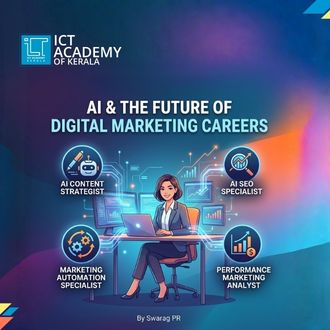
For years, the headlines have framed artificial intelligence as a threat to marketing jobs. The reality on the ground looks different. AI is automating repetitive tasks — yes — but it is also creating entirely new job titles, new skill requirements, and new hiring demand across the marketing industry. For students weighing career options, graduates entering the job market, and professionals deciding where to invest their next round of upskilling, the AI-powered digital marketing space is quickly becoming one of the more promising places to build a career.
This guide walks through how AI is reshaping marketing work, the specific new roles it has created, and practical steps for starting or pivoting into a career in AI-powered digital marketing.
Why AI Is Creating More Jobs Instead of Replacing Them
Human Creativity and Strategic Thinking Still Matter
AI is excellent at pattern recognition, drafting, and analysis, but it doesn’t understand brand, cultural context, or long-term strategy the way a human marketer does. Businesses still need people who can set direction, interpret AI output critically, and make judgment calls that tools can’t.
AI as a Productivity Partner, Not a Substitute
The most effective marketing organizations treat AI as a productivity multiplier rather than a replacement for people. Gartner’s own research bears this out: even as marketing teams invest heavily in AI, labor’s share of marketing budgets actually increased — from 21.9% in 2025 to 24.5% in 2026 — suggesting companies are investing more in skilled talent as they adopt AI, rather than cutting headcount. (Gartner, via MarTech)
Why AI Created New Job Roles
The World Economic Forum’s Future of Jobs Report 2025 remains the most cited labour-market study on this topic, and its numbers are striking: by 2030, AI and related technologies are expected to displace 92 million jobs globally but create 170 million new ones — a net increase of 78 million jobs worldwide. (World Economic Forum, January 2025) The same report found that nearly 40% of core job skills are expected to change by 2030, with AI and big data topping the list of fastest-growing skill demands.
LinkedIn’s Economic Graph data adds a more recent, marketing-relevant data point: AI adoption has already generated more than 1.3 million new roles globally, including titles that didn’t exist a few years ago, and postings requiring AI skills in non-technical fields like marketing and finance climbed more than 70% year-over-year as of early 2026. (LinkedIn Economic Graph, via World Economic Forum)
Growing Employer Demand for AI-Skilled Marketers
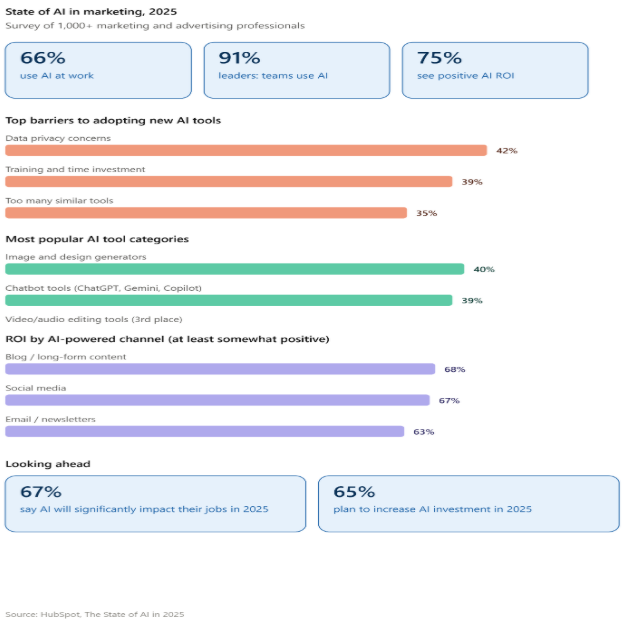
Adoption inside marketing teams themselves has moved fast. HubSpot’s 2025 State of AI research, based on a survey of over 1,000 marketing and advertising professionals, found that 91% of marketing leaders say employees at their organization already use AI to help do their jobs. (HubSpot, 2025 State of AI Report) That level of day-to-day usage doesn’t reduce headcount needs — it raises the bar for what marketers are expected to know, which is exactly why AI-literate candidates are becoming more employable, not less.
| 170M
new jobs projected globally by 2030 — WEF |
24.5%
of marketing budgets now spent on labor, up from 21.9% — Gartner |
+70%
YoY growth in postings requiring AI skills in marketing — LinkedIn |
91%
of marketing leaders say staff already use AI at work — HubSpot |
New Career Opportunities Created by AI
AI hasn’t just changed how existing marketing roles work — it has created entirely new job titles. Some of the most in-demand include:
- AI Content Strategist
Sits above individual content pieces and owns the roadmap: what gets published, why, and how it ladders up to business goals. Uses AI tools (Claude, ChatGPT, Jasper, and others) to draft and scale output, but the real value-add is editorial judgment — catching when AI output sounds generic, enforcing brand voice guidelines, and deciding what not to publish. Reports to a marketing director; increasingly a bridge role between content teams and SEO teams.
CORE SKILLS Editorial judgment, brand voice documentation, content ops workflows, basic prompt iteration.
- AI SEO Specialist
Traditional SEO plus a layer of new complexity: optimizing for AI-driven search (Google’s AI Overviews, ChatGPT/Perplexity citations) alongside classic organic rankings. Uses AI for keyword clustering, content gap analysis, and generating optimization briefs at scale, but has to understand how large language models retrieve and cite content differently than traditional crawlers.
CORE SKILLS Technical SEO fundamentals, schema markup, understanding of how LLMs surface and cite sources, tool fluency.
- Marketing Automation Specialist
The “plumbing” role — builds workflows connecting email, CRM, and lifecycle marketing (e.g., HubSpot, Marketo, Salesforce). AI here means smarter trigger logic, predictive send-time optimization, and dynamic content personalization at scale. This role existed before AI, but the AI layer has raised expectations for what “automated” means — from simple drip campaigns to adaptive, behavior-triggered journeys.
CORE SKILLS CRM platform expertise, workflow and logic building, basic data hygiene; some SQL is a plus.
- Performance Marketing Analyst
Owns paid media (search, social, programmatic) and uses AI-powered platforms (Google Performance Max, Meta Advantage+) that increasingly automate bidding and targeting decisions. The human job shifts from manual bid management to strategic oversight: setting guardrails, interpreting whether the algorithm’s decisions make sense, and diagnosing when “AI optimization” quietly wastes spend.
CORE SKILLS Budget and ROI analysis, platform-specific ad tools, statistical literacy.
- AI Social Media Manager
Manages content calendars and scheduling with AI assistance for caption generation, trend-spotting, and even basic visual or video creation. The judgment layer is knowing which AI-generated content actually fits platform culture (what works on TikTok reads as tone-deaf on LinkedIn) and managing real-time community engagement, which AI still handles poorly.
CORE SKILLS Platform-native content sense, community management, AI content-generation tools (Canva AI, CapCut AI, etc.), crisis and reputation awareness.
- Prompt Engineer
The most AI-native title on the list, and arguably the most likely to evolve or partially disappear as tools improve — worth noting, some analysts think “prompt engineering” is already becoming a built-in skill rather than a standalone job. In marketing specifically, it means designing reusable prompt systems that reliably produce on-brand output: less “clever one-off prompts,” more prompt libraries and templates other teams can use.
CORE SKILLS Systematic testing and iteration, understanding of model behavior and limitations, documentation discipline.
- Marketing Data Analyst
Takes AI-generated insights (from analytics platforms, attribution models, predictive tools) and translates them into decisions leadership can act on. The AI does the pattern-detection; the analyst does the “so what” — checking whether correlations are meaningful, spotting when a model’s confidence is misplaced, and framing findings for non-technical stakeholders.
CORE SKILLS Statistics, data visualization, critical evaluation of model output, storytelling with data.
- AI Campaign Manager
A generalist and orchestrator role — runs campaigns end-to-end, coordinating content, paid, automation, and analytics functions, using AI tools throughout but keeping strategic ownership. Effectively a project-manager-plus role for the AI-marketing era.
CORE SKILLS Cross-functional coordination, campaign planning, enough fluency across the other roles above to manage them.
- Customer Experience Specialist
Focused on the personalization and support layer — chatbots, AI-driven recommendation engines, personalized journey mapping. The tension in this role is balancing automation with authentic service; poorly tuned AI personalization and chatbots are a common source of customer complaints, so this role often does as much AI quality control as AI deployment.
CORE SKILLS Customer journey mapping, chatbot and CRM platform knowledge, UX sensibility.
- AI Marketing Consultant
Externally facing (agency or freelance), advising businesses — often SMBs without in-house AI expertise — on which tools and workflows to adopt. Requires the broadest but shallowest technical knowledge of the list, paired with strong client-facing and advisory skills. This is the role Gartner’s “70% of CMOs say their processes aren’t mature enough” stat points to directly: real demand for a translator between AI capability and business need.
CORE SKILLS Breadth across marketing and AI tools, business consulting and advisory skills, ability to assess ROI of tools rather than just their features.
These roles are showing up across a wide range of industries actively hiring for AI-powered marketing skills, including e-commerce, healthcare, education, finance, SaaS, travel and tourism, real estate, startups, and IT services.
How to Start a Career in AI Digital Marketing
- Learn Marketing Fundamentals — AI tools are only as effective as the strategy behind them. A solid grounding in core marketing principles — audience research, positioning, funnels, and channel strategy — is still the foundation everything else is built on.
- Master AI Tools — Get hands-on with the AI tools actively used across content creation, SEO, paid advertising, email automation, and analytics. Familiarity with multiple tools, rather than just one, makes candidates more adaptable.
- Build Real Projects — Apply what you’re learning to real or simulated campaigns. Employers want to see how you use AI to solve marketing problems, not just that you’ve heard of the tools.
- Create a Portfolio — Document your projects, results, and the reasoning behind your AI-assisted decisions. A portfolio that shows judgment, not just tool usage, stands out.
- Earn Certifications — Structured, industry-recognized AI digital marketing certifications help validate your skills to employers, especially when you’re transitioning from another field or don’t yet have direct marketing experience.
- Keep Learning — AI tools and best practices evolve quickly. Marketers who stay current with new capabilities and platform updates maintain a real edge over those who stop learning after their first course.
This career path is future-proof for a simple reason: demand for AI-literate marketers is growing, productivity gains are real, salary leverage favors skilled candidates, remote and global opportunities are expanding, and the underlying technology keeps creating new specializations rather than closing off old ones.
Conclusion
AI is not eliminating digital marketing careers — it’s reshaping them and creating new ones in the process. From AI Content Strategists to Prompt Engineers, the roles emerging today didn’t exist a few years ago, and employer demand for people who can bridge marketing strategy with AI tools continues to grow. For students, graduates, career changers, and entrepreneurs alike, the opportunity isn’t to compete with AI — it’s to build the skills that let you work alongside it.
The path forward is continuous learning and adaptability. Treat AI as an opportunity to expand what you’re capable of, not a threat to your career.
____________________________________________________________________
About the Author
Swarag P.R.
(Participant: Certified Specialist in Digital Marketing with AI Adoption)
Digital Marketing Professional | SEO Content Strategist | AI Marketing Enthusiast
Swarag specializes in AI-powered marketing, content strategy, and digital branding, and is passionate about helping students, graduates, and professionals build successful careers in digital marketing.
LinkedIn: https://www.linkedin.com/in/swarag1